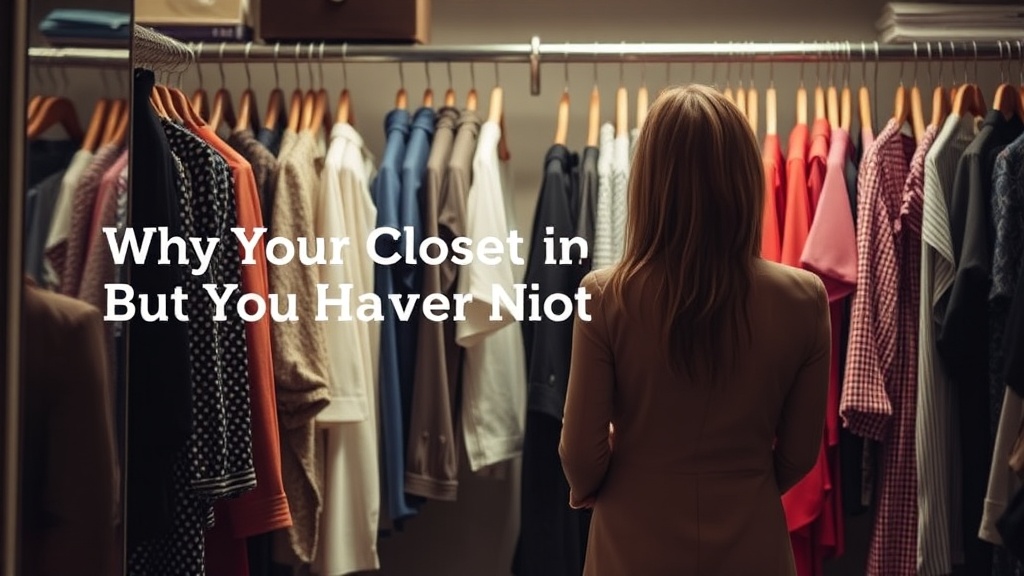
Why Your Closet Feels Full But You Have Nothing to Wear

Have you ever stood in front of a closet packed with clothes, staring at dozens of hangers, only to feel a sense of complete emptiness? It's a frustrating paradox: you own more items than ever, yet the thought of getting dressed feels like a chore rather than an opportunity. This happens because a collection of clothes is not the same thing as a functional wardrobe. A true wardrobe relies on a cohesive system where pieces talk to one another, rather than a random assortment of one-off purchases that don't work together.
Most women fall into the trap of buying for a "future version" of themselves—the woman who goes to tropical vacations or the woman who attends black-tie galas—while neglecting the woman who actually lives in their current daily reality. When your purchases are driven by impulse or temporary trends instead of a set of internal rules, your closet becomes a graveyard of unwearable pieces. This post breaks down the mathematical reality of why your clothes aren't working and how to fix the logic behind your shopping habits.
Why do I have so many clothes but nothing to wear?
The short answer? You're likely buying "orphans." An orphan is a piece of clothing that is beautiful on its own but doesn't pair easily with anything else you already own. If you buy a bright, patterned skirt because it's on sale, but you don't own a top that complements that specific pattern, that skirt will sit in your closet gathering dust. To build a functional wardrobe, every new item should ideally work with at least three items you already own.
Think of it like a puzzle. If you keep buying pieces that don't fit the edges of your current collection, you'll never finish the picture. This is why many women find themselves stuck in a cycle of buying more to solve the problem of having nothing to wear. They think a new blouse will fix the issue, but if that blouse requires a specific pair of trousers they don't own, the cycle continues. Instead of looking for more, look for the glue that holds your pieces together.
A successful wardrobe relies on a foundation of high-quality basics. These aren't boring—they are the reliable workers of your closet. A well-fitting white button-down, a pair of dark denim, and a versatile blazer are the structural supports that allow your more "fun" pieces to actually shine. Without these, your more expressive items have nowhere to go.
How do I build a functional wardrobe from scratch?
Building a functional wardrobe isn't about a total overhaul; it's about intentionality. Start by auditing what you actually wear. If you find yourself reaching for the same three pairs of pants every week, investigate why. Is it the fit? The fabric? The way they make you feel? Once you identify the common thread in your successful outfits, you can shop for more of that specific "vibe."
Follow these three steps to restructure your approach:
- Identify your uniform: What is the outfit that makes you feel most capable? Is it a midi skirt and a sweater? Or wide-leg trousers and a tucked-in tee? Once you find your uniform, buy variations of it.
- Prioritize fabric over brand: A $40 linen blend shirt will always look better than a $200 polyester shirt that pills after two washes. Learn to read the care tags. Look for natural fibers like cotton, silk, and wool. You can check more about fabric quality and care on sites like Vogue to understand what high-quality materials actually feel like.
- The "Three-Outfit Rule": Before you hit the checkout button, ask yourself: "Can I wear this with three different things I already own?" If the answer is no, put it back.
By implementing this rule, you move away from the dopamine hit of a new purchase and toward the long-term satisfaction of a cohesive style. It's about the math of your closet, not the volume of it.
Can I still wear trendy pieces without looking dated?
Absolutely, but you have to treat trends like seasoning, not the main course. If your entire outfit is composed of current trends, you'll look like you're wearing a costume. The trick is to integrate one trendy element into a baseline of classic pieces. If a certain silhouette is currently popular, buy it in a neutral color or a high-quality fabric so it remains relevant longer.
For example, if "red" is the color of the season, don't buy a red jumpsuit that you'll only wear once. Buy a red silk scarf or a red cardigan that can be layered over your existing neutral wardrobe. This keeps you feeling current without the stress of a constantly shifting aesthetic. For more inspiration on how to style seasonal colors, checking out fashion-forward resources like Elle can help you see how professionals mix high and low fashion.
Remember, the goal isn't to look like a runway model; it's to look like the most polished version of yourself. A well-fitted pair of jeans and a crisp tee will always look more sophisticated than a trend-heavy outfit that fits poorly. Real style is the ability to make your clothes work for your life, not your life working around your clothes.
| Type of Piece | Role in Wardrobe | Longevity |
|---|---|---|
| Basics | The Foundation | High (Years) |
| Statement Piece | The Personality | Medium (Seasons) |
| Trend Item | The Accent | Low (Months) |
The next time you feel the urge to shop, stop and look at your current closet. Instead of seeing what's missing, see what's already there and how you can better connect the dots. A smart wardrobe is a built system, not a collection of things.