The Confidence System: Why Your Outfit Can't Think for You (And What Actually Works)

Every March 8th, the same carousel starts spinning. Wear red. Express yourself. Let your outfit do the talking.
And every March 8th, I think about the Thursday morning I watched a director-level woman — someone who managed 14 people and ran a $2M budget — spend 23 minutes in a bathroom at our office before a board presentation because she'd worn the "wrong" blazer and couldn't stop thinking about it.
She didn't need a better outfit. She needed to not be thinking about her outfit at all.
That's the thing nobody says out loud on International Women's Day: the goal isn't a more empowering wardrobe. The goal is a wardrobe that asks nothing of you.
The Myth I Watched Play Out for Ten Years
When I was in HR, I had an unusual vantage point. I saw women before high-stakes moments — performance reviews, promotions, difficult conversations with difficult people. And the pattern wasn't what I expected.
It wasn't that women didn't have enough to wear. Almost everyone had plenty. The problem was the questions. Is this too casual? Does this read as serious? Should I have worn the structured one? Does this color say what I need it to say today?
Decision fatigue is a documented cognitive phenomenon. Research suggests that making repeated choices — whether significant or trivial — draws from the same limited pool of mental resources. Show up to your 9 AM presentation having already spent 20 minutes in the closet, and you're negotiating with a partial tank before you've even said hello.
That's part of why Steve Jobs kept a closet full of identical black turtlenecks. Not because he had bad taste — but because he'd made the choice once and didn't want to make it again. Military dress codes, theater costume protocols, chef's whites — these aren't primarily about aesthetics either. They're about reservation. You wear the uniform so your brain stays available for the actual work.
The "dress for confidence" industry has it completely backwards. The outfit doesn't create confidence. A system that removes the outfit question creates the conditions for it.
The System That Actually Freed Me
After I left HR and started everydaystyle, I rebuilt my wardrobe from scratch around one principle: I should never have to make a real decision in the morning.
The framework I landed on has two parts. I call it uniform-core + third piece.
Uniform-core is three to four bottom/top combinations that I know work. Not "might work." Not "worked once at that thing three years ago." Work reliably, in any meeting, under any lighting, with any shoes I own. For me right now, that's:
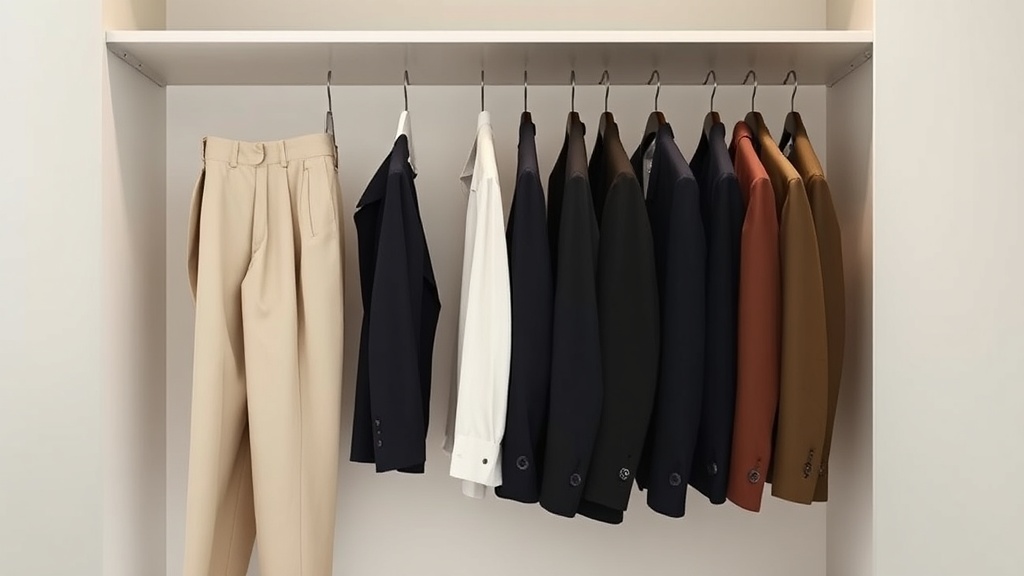
- Tailored wide-leg trouser in cream + fitted black top
- Straight-leg dark denim (hemmed to exactly 28") + structured white shirt
- Charcoal midi skirt + ribbed crew in navy or olive
These are non-negotiable workhorses. They are not boring because I know they're right. Knowing is the opposite of boring.
Third piece is where the morning variation lives — and it's exactly one decision, not twelve. A blazer or a cardigan or a scarf. One layer that shifts the register of the whole outfit up or down. That's the only question I ask myself: blazer or no blazer? Cardigan or nothing? One variable. One binary. Thirty seconds.
The result: I get dressed in under six minutes. Consistently. Including days when I have a podcast interview, a tricky client call, or something that used to trigger a full closet audit.
How to Build This in 90 Minutes
You don't need to overhaul everything. You need to find your core.
Step 1: Pull everything that works without question (15 minutes)
Not "might work with the right earrings." Not "works if I wear Spanx under it." Works. Right now. As is. Put it on the bed.
Step 2: Find the three pairings that come together automatically (20 minutes)
Look at what's on the bed and notice what goes together without effort. These are your uniform-core candidates. You're looking for combinations where you look at them and think yes rather than maybe.
Step 3: Identify your third-piece layer rotation (15 minutes)
What do you reach for to finish an outfit? For most people it's two or three things — a blazer, a cardigan, a structured jacket. Those are your third pieces. You don't need more than three.
Step 4: Do the math (5 minutes)
A $90 tailored trouser worn 80 times over two years costs $1.13/wear. A $280 statement piece worn four times before it stopped feeling right costs $70/wear. In my experience, the uniform-core wins the math reliably: lower cost per use, higher reliability, zero cognitive overhead.
Step 5: Box the "maybes" (35 minutes)
Everything in your closet that requires a question — a specific bra, a specific shoe, a specific mood, a specific amount of confidence — box it. Donate it, sell it, or move it somewhere that isn't your daily rotation. These are the items charging you a mental tax every morning even when you don't choose them.
What This Actually Has to Do With International Women's Day
Every year, the messaging is: here is a way to celebrate yourself through your clothing. Here is a color that signals your power. Here is a trend that says you've arrived.
I understand the impulse. Getting dressed intentionally can feel like an act of self-respect. I believe that.
But here's what I actually think about on March 8th: the most powerful thing a woman can do with her wardrobe is make it invisible.
Not invisible in the sense of shrinking or hiding. Invisible in the sense of decided. Done. Not occupying space in her head on the morning she needs that space for the pitch, the negotiation, the performance review, the hard conversation, the thing she's been building toward.
The system is the empowerment. The removing of the question is the act.
You didn't get dressed this morning. You executed a decision you made once, weeks ago, when you were calm and not running late and not already in your own head about everything you have to do.
That's what it looks like when your wardrobe works for you instead of against you.
The director who spent 23 minutes in the bathroom before the board presentation crushed it, by the way. She always did. But she went in rattled, with 23 fewer minutes of clean mental bandwidth than she deserved.
You shouldn't have to show up like that. Build the system. Remove the question. Walk in with a full tank.
That's the International Women's Day advice I actually believe.
Building your uniform-core and want a second set of eyes? I'm in the comments — and yes, I will absolutely tell you if your inseam is wrong.
You might also enjoy
The $28 Hem: Why Tailoring Cheap Clothes Beats Buying Expensive Ones — Discover how tailoring transforms budget pieces into wardrobe staples.